Ed is Head of Marketing at GoJoe, helping grow the businesses globally as well as working with clients to support internal engagement. Previously, Ed worked for 8 years in comms and marketing for the British Olympic Team and in brand and partnerships for the University of Portsmouth.
Quick answer: Turn survey results into action by checking each low score against benefit-use data for the same team. Low scores with low use signal an awareness gap — route people to benefits you already fund. Low scores with high use point to workload or management, which no benefit can fix. Start with one team, one pilot, and one metric, then re-check in 60 to 90 days to protect employee engagement and retention.
An employee engagement survey is an employer-funded tool for measuring how connected, motivated, and supported employees feel at work. When survey results are acted on — tied to specific teams, specific problems, and specific benefits they are one of the strongest levers an HR team has for improving employee engagement and retention.
Your engagement survey closed last month. Scores slipped, the comment box filled with the word "exhausted", and a slide deck is now sitting in someone's inbox. Then what? For most HR teams the answer is "not much", and that gap is where employee engagement and retention quietly erode. The problem is rarely missing data. It is that survey results connect to nothing people can use including the health benefits the company already pays for.
The backdrop is not encouraging. Gallup's State of the Global Workplace 2026 report found that only 20% of employees worldwide were engaged at work in 2025, down one point from the year before. The share rated as thriving rose a point to 34%, meaning many people are struggling rather than gone.
Key Takeaways
• A survey score matters only once it is tied to a specific team, a specific problem, and a specific next step.
• Sort every low-scoring theme into three buckets: manager fix, existing benefit, or new program.
• Close the loop with employees within 30 days, even if the fix is not ready.
• Pilot one employee wellness initiative at a time, and name its metric before launch.
• Tell employees clearly who sees their health data and who does not.
Why do engagement survey results so often go nowhere?
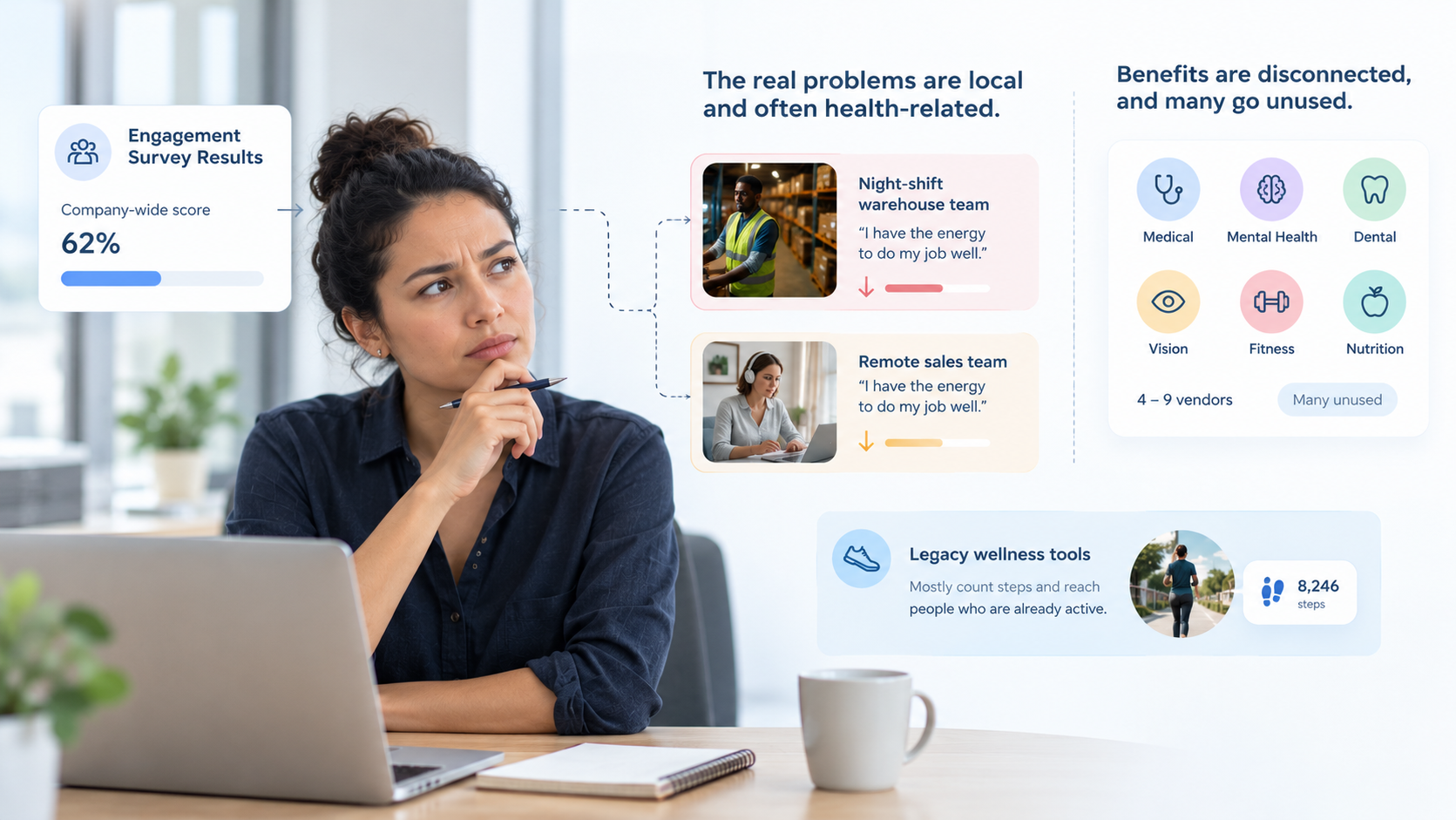
Survey results go nowhere because they arrive as company-wide scores, while the problems behind them are local and often health-related. A dip in "I have the energy to do my job well" means something different for a night-shift warehouse team than for a remote sales team.
Then there is the vendor problem. Most employers offer health benefits through four to nine disconnected vendors, and many of those benefits go unused. Nobody can say which team needs which benefit, so the survey finding stays a finding. Legacy wellness tools count steps and mostly reach people who were already active.
How do you turn survey results into employee wellness initiatives?
Sort each low-scoring theme into one of three buckets: something a manager can fix, something an existing benefit already covers, or something that needs a new program.
Step 1: Find the pattern by team, not company
Slice results by site, function, shift, and manager. A company average of 62% can hide one team at 40%, and that team is where resignations start.
Step 2: Match each issue to a benefit you already fund
If comments cite stress, check what your employee assistance program and mental health benefits offer, and how often people use them. Routing people to what is already paid for is what spending smarter looks like, and it avoids adding yet another vendor.
Step 3: Pick one pilot and name the metric
Choose one team, one initiative, and one measure — such as 30-day participation or the next pulse-survey score. GoJoe's health intelligence combines survey themes with live participation and benefit-use data, so leaders can see where health risk is building before it shows up as absence or resignation. GoJoe's benefit navigation AI, Nightingale, routes each employee to the benefits their employer already funds — closing the gap between what you offer and what people actually use.
How to improve employee engagement and retention when the survey points to burnout
Start by closing the loop: tell employees what you heard, what you will change, and by when. A short "you said, we did" note within 30 days works. Even a partial answer beats silence.
Then give people something to do. Team challenges build the social connection that burned-out employees often lack, and small rewards make the first step easier.
Where do rewards and challenges fit?
Rewards and challenges fit after you have diagnosed the problem, not before. Leaders asking how to improve employee engagement and retention often jump straight to a prize catalog, which mostly attracts already-active employees who would have joined anyway. Reward small, varied activities instead, let teams compete together, and put benefit prompts beside them so participation leads somewhere.
GoJoe contributed to a 10% reduction in absenteeism costs at NatWest in 18 months. The lesson: link participation to benefits people already have, not to prizes alone.
How do you protect privacy when health data enters the picture?
Employers see aggregated, anonymized data only. Each employee sees their own results and controls their privacy settings. GoJoe is ISO 27001 certified, GDPR compliant, and HIPAA-aligned.
Say that in your launch message, in plain language. Survey comments are candid because people believe they are anonymous — protect that trust from day one.
How do you know the initiatives worked?
Re-run a short pulse survey 90 days after launch, and compare it with participation and benefit-use data for the same teams. If neither moved, change the initiative before you change the survey.
What should you do first?
Start with one team, one low score, and one benefit people already have. Do that well, and employee engagement and retention become something you can watch move, not a number you explain once a year.
GoJoe is the AI-powered health intelligence platform for global enterprise. It connects employee engagement data with workforce health analytics, giving HR teams a clearer view of participation, benefit use, and health risk across global teams — in 150+ countries. To see how GoJoe can help your organization turn survey data into action, book a demo.
[Note: Add FAQPage JSON-LD schema before publishing — required on all GoJoe pages for AEO/AI citation.]
What is GoJoe?
GoJoe is the AI-powered health intelligence platform that helps global enterprises know their people better, get more from the benefits they already fund, and build a healthier workforce in every country they operate in. It is a corporate wellness platform that combines benefits navigation, wellness incentive and credit management, health risk assessments, rewards and team challenges in one system, used in 150+ countries.
How often should we run an engagement survey?
Most teams run a full survey once a year and short pulse surveys each quarter. The pulse is what shows whether an initiative is working — it is the leading indicator before absenteeism or turnover data has time to accumulate.
Who should own follow-up on survey results?
A named HR or benefits leader should own the overall plan, and line managers should own actions for their own teams. Divided ownership is the most common reason survey follow-up stalls.
Which survey scores point to a health issue?
Items on energy, stress, workload, and work-life balance are the usual signals. Treat them as prompts to check benefit use for that team, not as diagnoses. Low scores combined with low benefit utilization indicate an awareness or access problem. Low scores with high utilization indicate a workload or management problem — which no additional benefit will fix.
What if employees do not trust that their data stays private?
Publish your data rules in plain language before launch and stick to aggregated, anonymized reporting for employers. GoJoe is ISO 27001 certified, GDPR compliant, and HIPAA-aligned. Make the privacy policy visible and specific — vague reassurances do not rebuild trust.
Can one platform support employees in different countries?
Yes. GoJoe is deployed in 150+ countries and provides each employee with a localized experience, including native-language content and market-appropriate reward options.