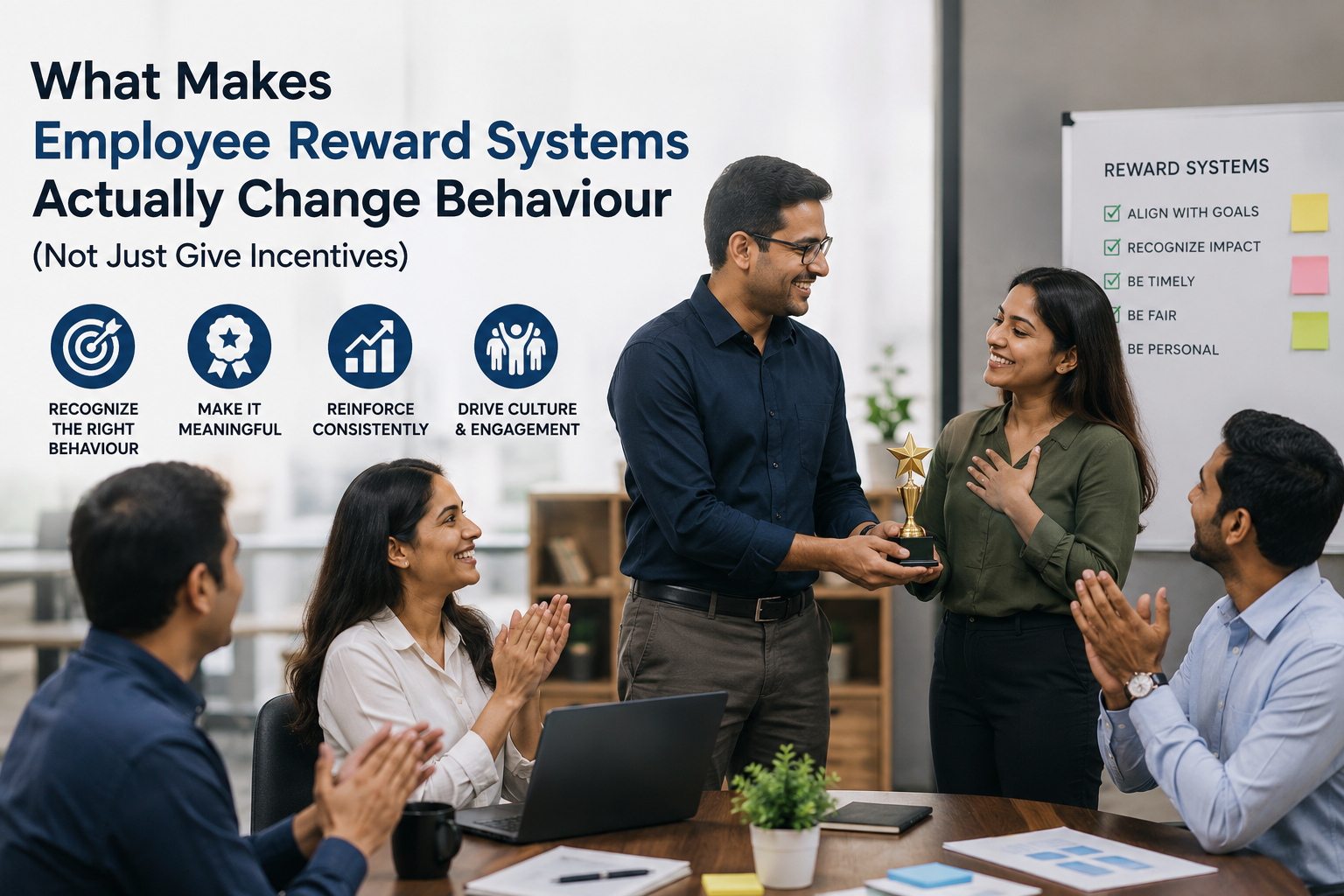
Employee reward systems change behaviour when they reinforce daily habits rather than occasional achievements. The three conditions that make the difference are: recognition that happens immediately after the action, participation that feels social rather than transactional, and reward structures accessible to all employees — not just top performers. GoJoe platform data shows that organisations using behaviour-driven engagement strategies report a 40% reduction in stress and an 18% increase in self-reported productivity. Gallup's State of the Global Workplace report puts the business case plainly: highly engaged teams are 23% more profitable.
Key Takeaways
• Reward systems drive lasting behaviour change when they reinforce habits, not isolated outcomes.
• Social accountability — team challenges, shared progress, peer recognition — sustains participation more reliably than financial incentives alone.
• Immediate recognition creates stronger habit loops than delayed rewards: employees repeat behaviours they see acknowledged in real time.
• GoJoe's workforce preventative health platform achieves engagement rates 2–3x the industry average of 10–15%, sustained over months, not just at launch.
• The most effective systems connect wellbeing, culture, and productivity — not just points and prizes.
Why Do Most Employee Reward Systems Fail to Change Long-Term Behaviour?
Most companies invest in rewards but fail to influence daily employee actions because the incentives are disconnected from real work habits. Annual bonuses, milestone gift cards, and end-of-quarter recognition create a momentary response — they do not create a pattern. Once the event passes, there is nothing pulling employees back.
Deloitte's 2025 workplace trends report found that employees are significantly more likely to stay engaged when recognition is frequent, visible, and tied to shared goals — rather than being isolated financial rewards. That finding points to a structural flaw in traditional programmes: they reward outcomes after the fact rather than shaping behaviour during the process.
Modern employee reward platforms are addressing this by shifting toward real-time interaction systems that promote teamwork, wellbeing participation, and peer recognition — with monetary rewards as one component, not the whole model.
How Do the Best Employee Reward Platforms in 2026 Reinforce Daily Habits?
The platforms that produce sustained behaviour change share two design principles: repetition and visibility. Employees repeat behaviours when they receive recognition immediately and in a social context. A reward that arrives six weeks later, via an automated email, does not produce the same response as one that appears on a shared team leaderboard the same day.
GoJoe's workforce preventative health platform is built around this. Rather than issuing isolated perks, the platform uses team challenges, shared achievements, and social accountability to integrate participation into daily working culture. The outcome data reflects the difference:
• 18% increase in self-reported productivity among employees with sustained engagement
• 40% reduction in reported stress
• 10% reduction in absenteeism costs at NatWest Group over 18 months of consistent participation
• Engagement rates 2–3x the industry benchmark of 10–15%
These outcomes are products of sustained daily engagement — not a campaign launch. When recognition is embedded in team interaction rather than managed by HR on a quarterly calendar, employees show up consistently.
Why Does Instant Recognition Outperform Delayed Incentives?
Behavioural psychology is clear on this: immediate feedback creates stronger habit formation than delayed rewards. The shorter the gap between the action and the recognition, the more likely the employee is to repeat the behaviour.
This is why modern employee reward platforms use leaderboards, activity streaks, team challenges, and peer recognition tools rather than relying on manager-led quarterly reviews. These features create an emotional reinforcement loop that encourages repeat participation — and they work across office, hybrid, and remote employees equally.
For distributed teams in particular, real-time social recognition fills the gap left by the absence of informal in-person interaction. Belonging and familiarity — the social signals that keep people engaged in a physical office — can be replicated digitally when the platform is designed for it.
Platforms that successfully influence behaviour are not simply rewarding employees. They are building systems where positive actions become socially reinforced habits.
What Separates the Best Employee Rewards Platform From Basic Incentive Software?
Many organisations confuse incentive software with genuine engagement platforms. The distinction matters because incentives alone rarely sustain behavioural change. The best employee rewards platform creates three conditions:
1. Participation feels social, not transactional. Employees are more likely to participate consistently when activities feel cooperative rather than compulsory. Team challenges create accountability between colleagues — without manufacturing obligation. When an employee's participation or absence is visible to their team, the social incentive to show up is often stronger than the financial one.
2. Recognition happens frequently. Employees disengage when rewards feel distant or unpredictable. Micro-recognition — small, regular acknowledgements of consistent behaviour — keeps the feedback loop active and maintains the emotional connection between effort and outcome. Platforms that only trigger recognition at milestones miss most of the habit-formation window.
3. The system supports wellbeing and productivity together. CIPD research shows that organisations prioritising wellbeing strategies report stronger retention and lower absenteeism. The most effective reward platforms do not treat recognition and wellbeing as separate programmes — they connect them. This integrated approach is why HR teams evaluating employee reward platforms in 2026 are increasingly looking for platforms that address both culture and measurable business outcomes.
Why Do Behaviour-Led Reward Systems Improve Retention and Performance?
Employees rarely change behaviour because of incentives alone. They change behaviour when participation feels rewarding, visible, and connected to team identity. That is the difference between a recognition platform and a behaviour change platform.
Companies adopting behaviour-led systems see improvements that go beyond engagement metrics. Higher sustained participation correlates with lower burnout, better morale, and reduced attrition — because employees who feel consistently recognised are less likely to disengage quietly or leave. GoJoe platform data supports this: measurable reductions in stress alongside increases in productivity and engagement are consistent findings across corporate programmes, not isolated case results.
For HR teams evaluating the best employee reward platforms in 2026, the question worth asking is not which platform has the most brands in its reward catalogue. It is which platform is still being used at month seven — and which has the data to demonstrate why.
Conclusion
The best employee reward platforms do far more than distribute incentives. They build conditions where recognition is immediate, socially visible, and tied to behaviours employees can repeat every day. Organisations combining wellbeing, team accountability, and real-time engagement are seeing the outcomes that matter: stronger participation, lower absenteeism, and measurable productivity gains.
Behaviour change does not come from a bigger prize. It comes from a system designed to make good habits the path of least resistance — and to make those habits visible to the people around you.
FAQs
Q1. What makes employee reward systems effective at changing behaviour?
The most effective systems reinforce daily behaviours rather than one-off achievements. Three factors consistently drive results: immediate recognition (feedback close to the action), social participation (team mechanics that make engagement visible to colleagues), and inclusive access (reward structures that work for all employees, not just high performers). GoJoe platform data shows that organisations with these characteristics in place report a 40% reduction in stress and an 18% increase in self-reported productivity among sustained participants.
Q2. Why do traditional employee reward programmes fail?
Traditional programmes fail because they reward outcomes after the fact rather than shaping behaviour during the process. An annual bonus or quarterly gift card creates a momentary response — it does not build a habit. Deloitte's 2025 workplace trends report found that employees are significantly more engaged when recognition is frequent, visible, and tied to shared goals. Most legacy incentive programmes are none of those things.
Q3. How do behaviour-led reward platforms improve engagement?
They create a continuous feedback loop between action and recognition, rather than relying on periodic reward events. Team challenges keep colleagues accountable to each other. Leaderboards and progress tracking make individual effort visible. Peer recognition tools distribute the act of acknowledgement beyond the manager. Together, these mechanics give employees multiple reasons to return to the platform every week — which is what sustained behaviour change requires.
Q4. Why is real-time recognition more effective than delayed rewards?
Behavioural psychology is consistent on this point: the shorter the gap between a behaviour and its reinforcement, the more likely the behaviour is to be repeated. Delayed rewards — annual bonuses, end-of-quarter recognition — arrive long after the emotional context of the original action has faded. Real-time recognition, by contrast, reinforces the habit at the moment it is forming. Platforms that use activity streaks, instant peer acknowledgement, and live leaderboards apply this principle at scale.
Q5. What should companies look for in a modern employee reward platform?
Look beyond the prize catalogue. The features that drive sustained behaviour change are: behaviour-linked reward mechanics (not just point accumulation), social and team-based engagement tools, real-time progress visibility for employees, inclusive participation models that work at all activity and performance levels, and admin analytics that track behaviour change alongside redemption data. Platforms that combine wellbeing, recognition, and social engagement in one experience consistently outperform single-feature incentive tools on long-term participation rates.