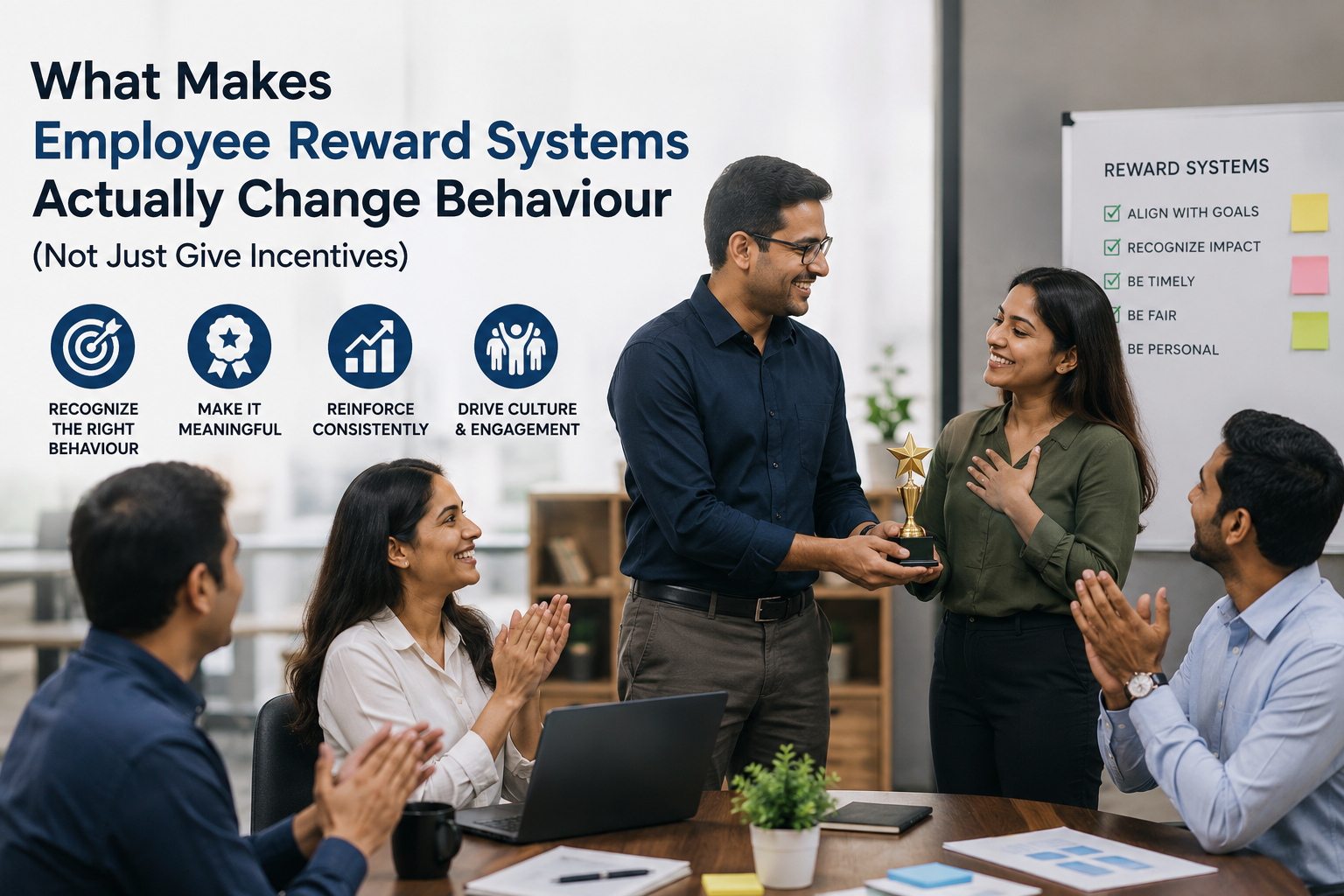
Quick Answer: Employee reward systems change behaviour when they reinforce daily habits rather than occasional achievements. The three conditions that matter: recognition happens immediately after the action, participation feels social rather than transactional, and reward structures are accessible to all employees — not just top performers. GoJoe platform data shows organisations using behaviour-driven engagement report a 40% reduction in stress and an 18% increase in self-reported productivity.
Employee reward systems change behaviour when they reinforce daily habits rather than occasional achievements. The three conditions that make the difference are: recognition that happens immediately after the action, participation that feels social rather than transactional, and reward structures accessible to all employees — not just top performers. GoJoe platform data shows that organisations using behaviour-driven engagement strategies report a 40% reduction in stress and an 18% increase in self-reported productivity. Gallup's State of the Global Workplace report puts the business case plainly: highly engaged teams are 23% more profitable.
Key Takeaways
• Reward systems drive lasting behaviour change when they reinforce habits, not isolated outcomes.
• Social accountability — team challenges, shared progress, peer recognition — sustains participation more reliably than financial incentives alone.
• Immediate recognition creates stronger habit loops than delayed rewards: employees repeat behaviours they see acknowledged in real time.
• GoJoe achieves engagement rates 2–3x the industry average of 10–15%, sustained over months, not just at launch.
• The most effective systems connect wellbeing, culture, and productivity — not just points and prizes.
Why Do Most Employee Reward Systems Fail to Change Long-Term Behaviour?
Most reward programmes start strong. Novelty drives short-term attention. Employees engage with the new system, collect their first rewards, and then the loop stops producing a meaningful response. When recognition becomes predictable and the process becomes transactional, employees disengage — not because they stopped caring, but because the system stopped working.
The data reflects this. Gallup's State of the Global Workplace report consistently finds that only around 21% of employees are engaged at work globally. Highly engaged teams outperform on virtually every business metric — productivity, absenteeism, retention — yet most reward programmes are not designed to produce engagement. They are designed to distribute recognition. The distinction matters more than most HR leaders realise.
What Makes Behaviour-Linked Rewards Different from Traditional Incentives?
Traditional incentive programmes reward outcomes. Behaviour-linked rewards reinforce the actions that produce outcomes. That shift in design logic changes everything about how employees respond.
When a reward arrives after a specific, repeatable behaviour — completing a team challenge, logging physical activity, collaborating with a colleague — the employee's brain creates a direct association between the action and the positive response. That association is what habit formation requires. A quarterly bonus for hitting a target does not produce the same effect, because the feedback loop is too long and too indirect to shape day-to-day decisions.
GoJoe's platform is built around this principle. The move-to-earn model links physical activity directly to redeemable voucher value across 9,000+ brands. The more employees move, the more they earn. The reward is automatic, immediate, and tied to a behaviour they can choose to repeat every day.
Why Does Social Accountability Sustain Participation Where Financial Incentives Fail?
Financial incentives create attention. Social accountability creates habits. The difference is that a cash prize is consumed once and forgotten, whereas a team challenge, a shared leaderboard, or a collective goal produces ongoing interaction that keeps employees returning to the platform.
When an employee's participation is visible to colleagues, the social incentive to show up is often stronger than any monetary reward. This is particularly true in distributed and hybrid workforces, where informal peer accountability does not happen naturally. GoJoe's team challenge format replicates that accountability layer digitally — making it possible to build genuine team connection across locations.
The outcome data bears this out. At Coutts Bank, GoJoe's approach produced a 43% increase in employee participation. At NatWest Group, sustained year-round engagement contributed to a 10% reduction in absenteeism costs over 18 months.
How Does Immediate Recognition Create Stronger Habit Formation?
The behavioural science is consistent: positive reinforcement is most effective when it follows the target behaviour as closely as possible. The longer the delay between an action and its acknowledgement, the weaker the association becomes — and the less likely the employee is to repeat the behaviour.
This is the structural weakness of most recognition programmes. End-of-month awards, quarterly bonuses, and annual reviews arrive long after the emotional context of the original action has faded. Employees receive evidence that their effort was noticed — but weeks or months too late for it to shape what they do tomorrow.
Real-time recognition closes that gap. GoJoe platform data shows that employees with consistent, frequent recognition report an 18% increase in self-reported productivity and a 40% reduction in stress. These outcomes are associated with sustained daily engagement — not a one-off incentive event.
What Should an Effective Employee Reward System Include in 2026?
The features that produce sustained behaviour change are not the ones that drive the most impressive launch-week sign-up numbers. They are the ones that keep employees engaged in month six.
The most effective systems share five characteristics: reward mechanics tied to specific, repeatable behaviours; social and team-based participation tools that create visible accountability; inclusive access for employees at all performance and activity levels; real-time feedback that closes the loop between action and recognition; and analytics that surface behaviour change data alongside redemption rates.
GoJoe combines all of these in a single platform. The result is a reward system that HR teams do not have to actively manage on a daily basis — it runs itself through team challenges, automated recognition, and social features that keep employees returning.
Frequently Asked Questions
What makes employee reward systems effective at changing behaviour?
The most effective systems reinforce daily behaviours rather than one-off achievements. Three factors drive results: immediate recognition, social participation through team mechanics, and inclusive access for all employees. GoJoe platform data shows organisations with these characteristics report a 40% reduction in stress and an 18% increase in self-reported productivity.
Why do traditional employee reward programmes fail?
Traditional programmes fail because they reward outcomes after the fact rather than shaping behaviour during the process. Annual bonuses or quarterly gift cards create a momentary response — they do not build a habit. Deloitte research found employees are significantly more engaged when recognition is frequent, visible, and tied to shared goals.
How do behaviour-led reward platforms improve engagement?
They create a continuous feedback loop between action and recognition through team challenges, leaderboards, and peer recognition tools. These mechanics give employees multiple reasons to return to the platform every week — which is what sustained behaviour change requires.
Why is real-time recognition more effective than delayed rewards?
The shorter the gap between a behaviour and its reinforcement, the more likely the behaviour is to be repeated. Delayed rewards arrive long after the emotional context has faded. Real-time recognition reinforces the habit at the moment it forms.
What should companies look for in a modern employee reward platform?
Look for behaviour-linked reward mechanics, social and team-based engagement tools, real-time progress visibility, inclusive participation models that work at all performance levels, and admin analytics that track behaviour change alongside redemption data.