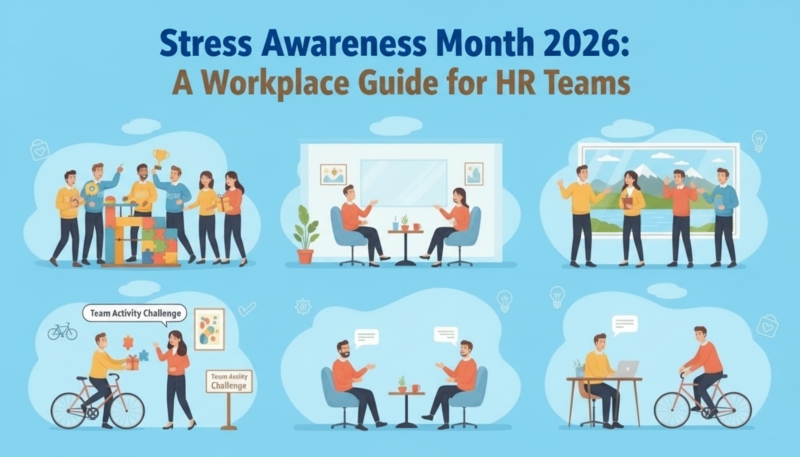
April is Stress Awareness Month. For HR teams, that means one thing: the spotlight is on workplace wellbeing, and the pressure is on to move beyond awareness and into action.
The 2026 theme; Be the Change is a direct challenge to organisations. Not 'share a post'. Not 'send a newsletter'. Actually change something. This guide gives you the practical framework to do exactly that.
Why Workplace Stress Demands More Than a Poster Campaign
Work-related stress is not a soft issue. It has hard numbers behind it — and those numbers are getting worse.
📊 964,000 UK workers reported work-related stress, depression, or anxiety in 2024/25 (HSE)
📊 22 million working days were lost to work-related stress in the same period (HSE)
📊 91% of employees experienced high stress or workplace pressure in the past year
📊 1 in 4 workers say they feel unable to cope with workplace pressure
📊 Each stress-related absence lasts an average of 23 working days (HSE)
Stress costs UK employers an estimated £51 billion per year through absence, presenteeism, and reduced performance (Deloitte). And it compounds: stressed employees are less engaged, more likely to leave, and more likely to get physically ill.
Stress Awareness Month is not the problem. The problem is that most organisations treat it as a communications exercise rather than an operational one. This guide is for teams that want to do more.
What Is Stress Awareness Month 2026?
Stress Awareness Month has run every April since 1992, organised by the Stress Management Society. The 2026 theme is Be the Change — drawing on the idea of personal agency and collective responsibility. The campaign encourages individuals and organisations to take meaningful action rather than passive acknowledgement.
For employers, Be the Change is a useful frame: the question is not whether your employees are stressed, but what you are specifically changing this month to help them. The sections below give you eight actionable answers.
8 Ways HR Teams Can Take Action This April
1. Make Physical Activity a Team Sport
The research is clear: physical activity is one of the most effective stress reduction tools available to employers. A 2025 systematic review found that over 60% of workplace physical activity interventions successfully reduced psychological stress. A separate meta-analysis showed a 31% decrease in depression symptom scores when employees increased their activity levels.
The challenge is that most workplace fitness programmes engage the people who are already active. The already-motivated 20% sign up; the other 80% sit it out. That 80% is where the stress problem lives.
The answer is team-based, whole-workforce challenges — where participation is social, the activities are inclusive, and the experience is genuinely fun. When employees move together rather than alone, the numbers tell the story: of employees who join a GoJoe challenge, an average of 90% actively participate throughout — well above industry norms. And the wellbeing impact is rapid: 70% of GoJoe users report improved wellbeing within just two weeks of starting a challenge. NatWest saw a 10% reduction in absenteeism within 18 months of running GoJoe programmes — a direct proxy for stress levels across the workforce. Centrica reversed a 15-month rising absenteeism trend. Hilti reported that 51% of employees felt more connected to colleagues after running team challenges.
Run a Stress Awareness Month Team Challenge with GoJoe
60+ activities tracked — not just steps. Walking, cycling, yoga, swimming, strength training and more.
Team-based format means social accountability drives participation across the whole workforce.
Move-to-earn rewards: employees earn points for activity, redeemable for real rewards.
Takes minutes to set up. Live during April, with real-time leaderboards and team progress visible to everyone.
90% of challenge participants actively take part throughout — including employees who have never engaged with a wellbeing programme before.
Start a Stress Awareness Month challenge →
2. Train Your Managers — Stress Starts and Ends There
Managers account for 70% of the variance in employee engagement (Gallup). The same is true for stress. A poor manager creates stress. A well-trained manager catches it early, has the right conversations, and adjusts workloads before people burn out.
Stress Awareness Month is the right moment to run a short manager training session on: how to spot early stress signals, how to have a psychologically safe check-in conversation, and what support they can refer to.
The HSE's Management Standards provide the framework. Train against those six categories — demands, control, support, relationships, role, and change — and you have a defensible, legally compliant approach.
3. Audit Workloads, Not Just Wellbeing Programmes
Most stress at work is caused by workload, lack of control, and poor role clarity — not by a shortage of wellbeing apps. Before running another workshop, run a workload audit: are your teams genuinely overloaded? Are priorities clear? Do people know what to say no to?
April is a good time to survey employees on their actual workload experience. Short (five-question), anonymous, and acted on publicly. Stress Awareness Month only means something if the findings go somewhere.
4. Create Structured Space for Honest Conversations
Stigma is still a significant barrier. Many employees do not disclose stress until it has become a serious mental health issue — by which point absence is almost inevitable. Creating structured, non-performative space for honest conversations reduces that gap.
Practical formats: team check-in rituals (ten minutes at the start of a weekly meeting), designated mental health champions with visible visibility, anonymous pulse surveys run fortnightly rather than annually. The goal is normalisation, not spectacle.
5. Review Your Employee Assistance Programme — and Tell People It Exists
Most UK employers have an Employee Assistance Programme (EAP). Most employees do not know they have access to one, and of those that do, few use it. Stress Awareness Month is the highest-visibility moment in the year to communicate what support is actually available.
Go beyond the intranet link. A direct, personal message from HR or the CEO — explaining what the EAP covers, how to access it confidentially, and removing any stigma around using it — can shift utilisation rates significantly. See our guide to what an EAP is and how it works for a fuller overview.
6. Take Flexible Working Seriously
Autonomy over working patterns is consistently cited as one of the most powerful stress reduction factors available to employers. The data from the CIPD is consistent year on year: employees with flexibility in how, when, and where they work report significantly lower stress levels than those without.
April is a good time to audit whether your flexible working policies are genuinely flexible or nominally flexible. 'We have a hybrid policy' is not the same as 'our people have meaningful control over their schedule'.
7. Address the Physical Environment
Noise, poor lighting, uncomfortable temperatures, and lack of private space are consistent stress amplifiers — particularly in open-plan offices and contact centres. They are also the most overlooked category of stress intervention.
Run a simple facilities survey. Identify the top three physical environment complaints. Fix them. It is faster and cheaper than most wellbeing programmes, and the impact on daily stress levels is immediate.
8. Build for Year-Round Impact, Not a One-Month Spike
The most common failure mode for Stress Awareness Month is that it stays in April. A poster comes down in May; the problem does not.
The organisations that genuinely reduce workplace stress build it into the operating rhythm of the business: regular pulse surveys, manager training as standard, an employee wellbeing programme that runs quarterly, and team challenges that give people a reason to move and connect year-round — not just in April.
Be the Change is not an April ask. It is an organisational design question.
Why Physical Activity Is Your Highest-Leverage Stress Intervention
Of all the levers available to HR teams, physical activity has the strongest evidence base. Exercise reduces cortisol (the primary stress hormone), improves sleep quality, increases self-efficacy, and — critically — reduces psychological stress regardless of the type of activity or the fitness level of the participant.
The research is no longer equivocal. A 2025 systematic review of workplace physical activity programmes found that improved psychological wellbeing was the most commonly reported outcome, with stress reduction appearing in 60%+ of all studies. A Fortune 500 company running a structured team activity programme reported an 18% reduction in annual medical expenditure.
The barrier is not evidence. The barrier is engagement. Traditional fitness programmes exclude the people who most need them. A solution built around team challenges, diverse activities, and social mechanics — not individual step targets — is what converts the sceptics. That is the principle behind GoJoe's workforce fitness challenge platform: move together, reward everyone, change behaviour at scale.
Frequently Asked Questions
What is Stress Awareness Month and when is it?
Stress Awareness Month takes place every April and has done since 1992. It is organised by the Stress Management Society and exists to increase public and organisational awareness of the causes and consequences of stress. The 2026 theme is Be the Change, encouraging individuals and organisations to take active, meaningful steps rather than passive acknowledgement.
What are the main causes of workplace stress in the UK?
According to the HSE's Management Standards, the primary causes of workplace stress are: workload (too much, too complex, or unclear priorities), lack of control over work, inadequate support from managers or colleagues, poor workplace relationships including conflict, role ambiguity, and poor management of change. Addressing these systematically is more effective than generic wellbeing programmes.
How can employers reduce stress in the workplace?
The most effective employer interventions combine: manager training in early identification and psychologically safe conversations, workload audits to address root causes, structured physical activity programmes that engage the whole workforce (not just the already-active), improved flexible working, and year-round wellbeing infrastructure rather than one-month campaigns. Team-based fitness challenges are particularly effective because they address both physical health and social connection — two of the strongest protective factors against stress.
Does exercise actually reduce workplace stress?
Yes — the evidence is strong. A 2025 systematic review found that over 60% of workplace physical activity interventions successfully reduced psychological stress. A separate meta-analysis showed a 31% decrease in depression symptom scores when employees increased their activity levels. Exercise reduces cortisol, improves sleep, and increases resilience. The key is designing programmes that include the whole workforce — not just people who are already active.
What should HR teams do during Stress Awareness Month?
Stress Awareness Month is most valuable when used as a trigger to implement lasting change rather than a communications moment. High-impact actions include: running a team fitness challenge across the whole workforce, training managers on stress identification and support conversations, auditing and communicating EAP access, surveying employees on workloads and acting on the findings, and launching a year-round wellbeing programme that continues after April.
Ready to Run a Stress Awareness Month Challenge?
GoJoe makes it simple to run a whole-workforce team fitness challenge this April. 60+ tracked activities, move-to-earn rewards, and social team mechanics that drive participation across every type of employee — not just the gym-goers.
90% of challenge participants actively take part throughout. 70% of users report improved wellbeing within two weeks. NatWest cut absenteeism by 10% in 18 months. Centrica reversed a 15-month rising absence trend. And previously inactive employees increase their activity levels by 400% on average. Learn more about running a team fitness challenge or explore GoJoe's full employee wellbeing platform.
Sources
- HSE Work-related stress statistics, 2024/25
- Deloitte: Mental Health and Employers, 2022 — £51bn annual cost estimate
- Gallup: State of the Global Workplace 2024 — manager variance in engagement
- Systematic review: Effectiveness of Physical Activity-Led Workplace Health Promotion Interventions, Healthcare (MDPI), 2025
- Stress Management Society: Stress Awareness Month 2026 — Be the Change