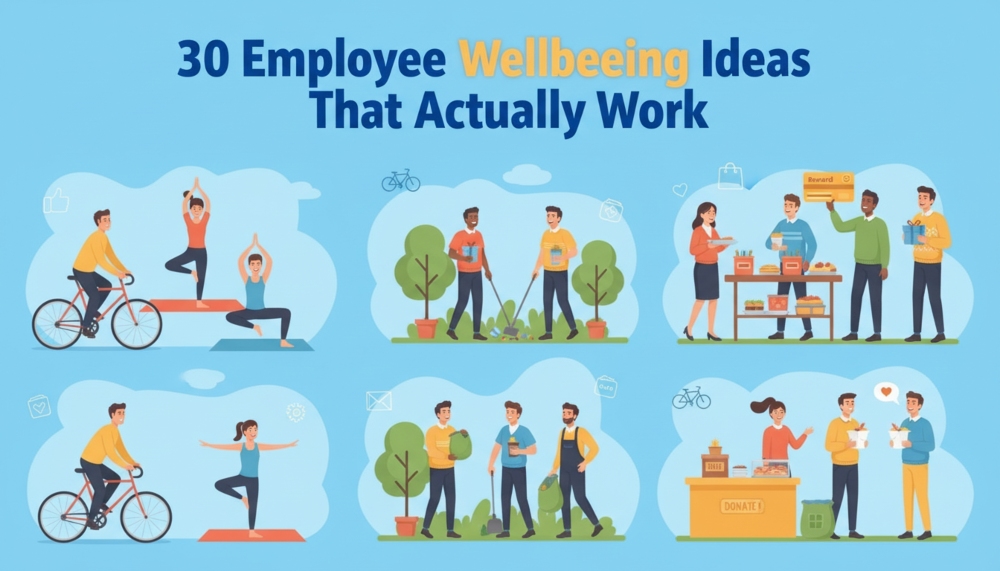
Quick Answer: The most effective employee wellbeing ideas for UK workplaces in 2026 combine physical activity programmes, mental health infrastructure, financial security support, social connection, flexible working, and manager capability training. Team-based fitness challenges consistently deliver the highest participation (GoJoe clients average 90%+) and among the fastest measurable outcomes — 70% of participants report improved wellbeing within two weeks. Start with physical activity and manager training; these two levers impact every other pillar.
UK employers are facing a wellbeing crisis. Sickness absence hit a 15-year high in 2024, costing the average business 9.4 days per employee per year. Mental health problems now cost UK employers an estimated £56 billion annually. And according to Mental Health UK's 2026 Burnout Report, nine in ten adults are experiencing high or extreme levels of stress — with one in five workers taking time off as a direct result.
The good news: wellbeing investment works. Employees whose employers genuinely support wellbeing are more engaged, more productive, and significantly more likely to stay. 88% of UK workers say wellbeing is now as important to them as pay.
This guide covers 40 employee wellbeing ideas that actually make a difference — from quick wins to structural programmes — organised by the six pillars of workplace wellbeing most likely to move the needle in 2026. If you're also evaluating software to support your programme, see our guide to the best employee wellbeing apps in the UK for 2026.
What Are the 6 Pillars of Employee Wellbeing in 2026?
Effective wellbeing programmes address all six dimensions: physical health, mental health, financial security, social connection, flexible autonomy, and — critically in 2026 — manager capability. Organisations that treat wellbeing as a single-pillar initiative (usually gym membership + an EAP) consistently underperform on engagement and retention metrics.
Physical Health & Fitness (Ideas 1–8)
Physical activity is the most evidence-backed lever in workplace wellbeing. Regular exercise reduces absenteeism, improves cognitive function, and increases resilience to stress — yet 37% of UK office workers are classified as physically inactive during the working week. GoJoe's own data shows 3 in 4 employees exceed WHO physical inactivity guidelines — meaning most workforce wellbeing programmes are starting from a much lower baseline than HR teams realise.
1. Run a company fitness challenge
Step challenges, cycling challenges, and active minutes competitions create team-level accountability and make physical activity social rather than solitary. GoJoe clients consistently see 90%+ employee participation — dramatically higher than traditional gym schemes — because the format removes the intimidation of solo exercise and replaces it with friendly competition. NatWest saw a 10% reduction in absenteeism after running challenges on the platform. Coutts achieved 43% workforce participation within the first challenge cycle.
2. Subsidise gym memberships or fitness apps
A discounted or fully funded gym benefit is still valued — but works best as a complement to team-based activity rather than a standalone offer. Consider offering a choice of provider so employees can choose what suits them, from traditional gym to yoga studios to cycling apps.
3. Introduce walking meetings
Replace back-to-back desk-based 1:1s with a walking equivalent. The format naturally limits meeting length, reduces screen fatigue, and builds in movement without requiring any additional time commitment from employees.
4. Provide standing or sit-stand desks
Prolonged sitting is independently linked to cardiovascular risk, back pain, and reduced energy. Sit-stand desks are now cost-effective (from ~£300) and deliver measurable improvements in reported energy levels and productivity within 12 weeks.
5. Create active commuting incentives
Cycle to Work schemes offer tax savings of up to 42% on bikes and equipment. Combine with secure bike storage, showers, and a challenge to track active commutes — GoJoe's platform tracks any GPS activity, including commutes, so these count toward team challenge totals automatically.
6. Offer lunchtime activity classes
On-site or virtual yoga, HIIT, or pilates during the lunch break removes the barrier of evening gym attendance. Participation rates for lunchtime sessions typically outperform before/after-work equivalents, particularly for parents and carers.
7. Build step/activity targets into recognition programmes
Tie physical activity milestones to visible recognition — leaderboards, digital badges, or small prizes. Visibility drives participation. GoJoe's platform data shows that organisations using social features (kudos, team feeds, leaderboards) see 400% more activity among previously inactive employees.
8. Create a dedicated wellbeing space
A quiet room that doubles as a stretching/mindfulness space requires minimal investment and signals that physical recovery is as legitimate as desk work. Particularly valued in open-plan offices where there's nowhere to decompress.
Mental Health & Resilience (Ideas 9–18)
Mental health is the leading cause of long-term absence in the UK, accounting for more than half of all long-term sick leave. The 2026 challenge isn't awareness — it's moving from campaigns to genuine infrastructure that supports people when they need it.
9. Train Mental Health First Aiders
Mental Health First Aiders (MHFAs) are trained employees who provide a first point of contact for colleagues experiencing distress. MHFA England recommends one MHFA per 10 employees. Training takes two days and costs around £300 per person — far less than the cost of a single long-term absence.
10. Upgrade your EAP — and actually promote it
Most organisations have an Employee Assistance Programme. Most employees don't know what it covers or how to access it. Awareness of the EAP should be part of onboarding, featured in manager conversations, and reminded quarterly — not buried in the intranet. Usage rates below 5% indicate a communications failure, not a lack of need.
11. Build a proactive mental health pathway
Stop waiting for crisis. A proactive mental health pathway gives employees structured access to support before problems escalate: self-assessment tools, low-barrier counselling sessions (same-week availability), and a clear escalation route. This is now the benchmark for progressive UK employers and is consistently flagged in 2026 wellbeing trend reports.
12. Introduce structured burnout prevention
Mental Health UK's 2026 Burnout Report found that 27% of employees who took time off due to stress received no support on their return. Prevention is cheaper than recovery: schedule quarterly "pressure and pace" reviews for line managers, cap meeting hours per day, and normalise workload conversations before people hit breaking point.
13. Mandate minimum notice periods for out-of-hours contact
Ambiguity about when employees are "expected" to be contactable is a significant driver of chronic stress. A clear, written policy on out-of-hours communication — even if it simply states the norm rather than enforces it legally — significantly reduces reported anxiety around switch-off.
14. Offer mindfulness or meditation programmes
Apps like Headspace for Work and Calm for Business provide scalable mindfulness access. The evidence base is solid: eight weeks of regular practice reduces perceived stress and improves emotional regulation. Budget: from ~£5 per employee per month at scale.
15. Dedicate time for recovery
Introduce "recovery time" as an explicit feature of working life — not just holiday. This might mean protecting Friday afternoons from meetings, building buffer time into project plans, or formally recognising that sustained high performance requires planned recovery. Teams with recovery built in outperform those without on both quality and retention.
16. Create psychological safety in team culture
Psychological safety — the belief that it's safe to speak up, disagree, and make mistakes without punishment — is one of the strongest predictors of both wellbeing and performance. It's primarily built through leader behaviour: modelling vulnerability, rewarding honesty, and responding non-defensively to bad news.
17. Support employees returning from mental health absence
Return-to-work after mental health absence needs a structured plan: a phased return schedule, a dedicated point of contact, adjusted workload expectations, and a follow-up check-in at two weeks, six weeks, and three months. The absence of this structure is a key predictor of relapse.
18. Make menopause support explicit
One in ten UK women has left a job due to menopause symptoms. A menopause policy, trained line managers, and simple adjustments (temperature control, flexible hours, access to a GP) make an outsized difference in retaining experienced female talent. This is now mainstream practice, not a niche benefit.
Financial Wellbeing (Ideas 19–24)
Financial anxiety is a leading driver of presenteeism and disengagement. One in four UK employees has lost sleep over financial concerns — translating directly into reduced concentration, higher absence, and lower output at work. Financial wellbeing is no longer optional infrastructure.
19. Provide access to independent financial guidance
Partner with a financial guidance provider to give employees access to impartial, regulated advice on debt management, savings, and pension planning. This is distinct from selling them financial products — it's about improving financial literacy and reducing anxiety. Cost from ~£3 per employee per month through group schemes.
20. Introduce salary advance / flexible pay
Salary advance tools (Wagestream, Hastee) allow employees to access a portion of earned wages before payday, reducing reliance on high-interest credit in cash-flow emergencies. This is one of the highest-impact, lowest-cost financial wellbeing interventions available — and particularly valued by hourly-paid and junior employees.
21. Communicate pension benefits clearly and early
Most employees significantly underestimate their pension contributions and the value of employer matching. A simple annual pension statement explained in plain English — "your employer contributed £X this year on your behalf" — meaningfully increases perceived total compensation and reduces the temptation to leave for a marginal salary increase elsewhere.
22. Offer financial education workshops
One-hour lunch-and-learn sessions on topics like mortgages, ISAs, and managing cost-of-living increases are consistently highly rated by employees across all salary bands. Delivery can be in-person or virtual via specialist providers. Consider scheduling around key life events: tax year end, bonus season, and the January cash crunch.
23. Review and communicate your discount and cashback schemes
Perkbox, Reward Gateway, and similar platforms provide access to supermarket discounts and cashback on everyday spending worth hundreds of pounds per year. The barrier is awareness — fewer than a third of employees with access to these schemes use them regularly. Invest in the communication, not just the benefit.
24. Benchmark pay regularly and transparently
Pay anxiety — the concern that you're underpaid relative to market — is a persistent source of low-grade financial stress even for reasonably well-compensated employees. Regular, visible pay benchmarking and clear communication about how pay decisions are made reduces this anxiety significantly and builds trust in leadership.
Social Connection & Team Culture (Ideas 25–31)
Loneliness and disconnection at work are surging, particularly in hybrid and remote environments. Hilti, a GoJoe client, reported that 51% of employees felt more connected after running a company-wide health programme — demonstrating that the right social infrastructure can bridge remote/office divides at scale.
25. Run cross-team challenges
Structured competitions that mix departments or offices — fitness challenges, quiz leagues, sustainability challenges — build relationships that can't emerge from work tasks alone. The combination of shared goal, friendly rivalry, and visible progress is uniquely effective at creating genuine social bonds across otherwise siloed teams.
26. Establish a wellbeing committee or champions network
A network of volunteer wellbeing champions — one per team or department — gives wellbeing strategy grassroots reach. Champions can flag issues early, tailor initiatives to their team's needs, and make wellbeing feel locally relevant rather than centrally mandated.
27. Celebrate non-work contributions and milestones
Recognition of life events — new babies, house moves, personal achievements outside work — reinforces that the organisation sees employees as whole people. This is low-cost and high-impact for belonging, particularly in distributed teams where casual social awareness is reduced.
28. Protect social rituals from efficiency cuts
The team lunch, the end-of-project celebration, the informal Friday catch-up. These are often the first things cut in a cost-saving exercise and the last to return. Research consistently shows that informal social connection is more predictive of belonging than formal team-building events.
29. Build inclusive social activities
Alcohol-centric social events exclude significant portions of the workforce — people in recovery, those with health conditions, those with caring responsibilities, and many cultural and religious groups. A mix of activity types (including daytime, family-friendly, and alcohol-free options) signals that inclusion is genuine, not aspirational.
30. Create peer support structures
Buddy systems for new starters, peer mentoring for career development, and informal support networks for specific life stages (new parents, carers, people with long-term conditions) reduce isolation and build resilience. Particularly impactful in organisations with high turnover or rapid growth.
31. Use shared health programmes to reconnect remote and hybrid workers
Physical distance kills social connection unless it's actively countered. GoJoe's gamified health programmes — where everyone contributes to a shared goal regardless of location — are one of the most effective tools available for building genuine connection across distributed teams. Centrica used GoJoe to reverse a 15-month trend of declining team cohesion.
Flexible Working & Autonomy (Ideas 32–37)
Autonomy — the sense of control over when, where, and how you work — is one of the most powerful predictors of employee wellbeing and retention. The organisations that will win the talent market in 2026 are those that offer genuine flexibility, not performative flexibility.
32. Implement core hours rather than fixed hours
Core hours (e.g., 10am–3pm) give employees the flexibility to structure their day around personal commitments — school runs, medical appointments, personal training, caring responsibilities — without requiring annual leave. Adoption consistently improves reported wellbeing and reduces "hidden presenteeism."
33. Formalise and protect annual leave entitlements
UK employees left an average of 3.7 days of annual leave unused in 2025. This isn't a sign of engagement — it's a sign of workload pressure and a culture that implicitly discourages rest. Formalise a "use it or lose it" calendar reminder, prohibit leave carry-over beyond a defined maximum, and model senior leaders visibly taking full leave.
34. Offer compressed working week trials
The four-day week evidence base in the UK is now substantial, with multiple large-scale trials showing no reduction in productivity alongside significant improvements in wellbeing, attendance, and retention. Even a "trial" framing — run it for a quarter and measure — signals trust and generates meaningful data for the business case.
35. Enable career breaks and sabbaticals
Extended career breaks of 1–3 months for personal projects, travel, or caring responsibilities — even unpaid — generate disproportionate loyalty and retention impact. The employees most likely to take a career break are often the most valuable: high performers with options who stay because of genuine care rather than constraint.
36. Provide location flexibility without "proximity bias" penalties
Hybrid flexibility is undermined when remote employees are systematically less visible in promotion decisions. Address this directly: structured check-ins, objective performance criteria, and senior leadership modelling of remote work days. Flexibility without equity is just displacement of stress.
37. Design wellbeing into the workday structure
Calendar defaults, meeting-free blocks, and no-meeting lunchbreaks are structural interventions that don't require individual willpower. Set the meeting invite default to 25 minutes instead of 30. Block 12–1pm in everyone's calendar. These small structural nudges have disproportionate impact on recovery and concentration across the organisation.
Manager Capability & Leadership (Ideas 38–40) — the 2026 Priority
This is the most under-invested area in UK workplace wellbeing — and the most impactful. Mental Health UK's 2026 Burnout Report found that nearly one in three employers admits their managers lack the time, training, or resources to meaningfully support staff mental health. And over a third of workers don't feel comfortable raising stress with their manager at all — a figure that's getting worse year-on-year.
No wellbeing initiative lands unless managers have the capability to support it. A mindfulness app doesn't help if your manager schedules 6am meetings. A mental health policy doesn't work if managers don't know how to have a supportive conversation.
38. Invest in mental health conversation training for all managers
MHFA England's "Workplace Conversations" training gives managers a practical framework for spotting early warning signs, opening a conversation without overstepping professional boundaries, and signposting to appropriate support. This should be mandatory for all people managers, not optional CPD.
39. Build wellbeing into manager performance criteria
If managers are not measured on the wellbeing outcomes of their team, wellbeing will always lose to short-term delivery pressure. Add team wellbeing scores, absence rates, and 360-degree feedback on supportive behaviours to manager review criteria. What gets measured gets managed.
40. Give managers their own wellbeing support
Managers consistently have worse wellbeing outcomes than individual contributors — they absorb team stress while managing their own workloads and are less likely to use EAP services (due to perceived stigma about leadership vulnerability). Dedicated manager peer groups, coaching, and explicit permission to be struggling are non-negotiable for a healthy management layer.
How to Measure the ROI of Your Wellbeing Programme
The business case for wellbeing investment is clear. The challenge is measuring it rigorously enough to protect budget in a downturn. Track these four metrics before and after any major initiative:
Absence rate (days lost per employee per year — benchmark: 9.4 in UK 2024). Presenteeism score (ask employees directly: "In the last month, how often were you at work but not fully productive due to health or stress?"). Engagement score (from your annual survey). Voluntary turnover rate (track at 6-month intervals). GoJoe clients report ROI within 6–12 weeks, primarily through improved attendance and engagement scores.
Frequently Asked Questions
What are the most cost-effective employee wellbeing ideas for small businesses?
Walking meetings, flexible core hours, lunch-and-learn sessions, and team fitness challenges deliver the highest impact per pound spent. GoJoe's workforce wellbeing platform costs less per person than a single gym membership yet reaches the entire workforce including those who would never use a gym. Manager mental health training is also high-ROI given its effect across entire teams.
How do you improve employee wellbeing without a large HR budget?
Start with structural changes that cost nothing: protecting lunchbreaks, reducing out-of-hours contact expectations, and defaulting meeting lengths to 25 minutes. Then add a team fitness challenge (high participation, measurable outcomes, cost-effective). Only invest in more expensive benefits once you've identified the specific gaps in your workforce through a wellbeing survey.
What employee wellbeing initiatives have the best impact on retention?
According to 2026 research, the top retention drivers in wellbeing are: genuine flexible working (not just policy, but culture), manager capability to support mental health, financial wellbeing support (especially for junior employees), and social connection — particularly in hybrid teams. GoJoe's platform addresses the social connection and physical health pillars while being a highly visible signal of organisational care.
What is the difference between employee wellbeing and employee engagement?
Engagement measures how committed and motivated employees are to their work and organisation. Wellbeing measures how employees feel physically, mentally, and socially. The two are closely linked — poorly supported wellbeing reliably drives disengagement — but they require different interventions. High engagement with poor wellbeing is a burnout risk; high wellbeing with low engagement suggests misalignment between the employee's role and their motivation.
How do you get senior leadership buy-in for a wellbeing programme?
Lead with cost, not compassion. The sickness absence cost (9.4 days × average daily salary) is usually a stronger board-level argument than wellbeing in principle. Add the retention cost of voluntary turnover (typically 6–9 months' salary to replace a skilled employee) and the productivity cost of presenteeism. GoJoe provides pre-built ROI calculations and post-programme impact reports for exactly this purpose.