Ed is Head of Marketing at GoJoe, helping grow the businesses globally as well as working with clients to support internal engagement. Previously, Ed worked for 8 years in comms and marketing for the British Olympic Team and in brand and partnerships for the University of Portsmouth.
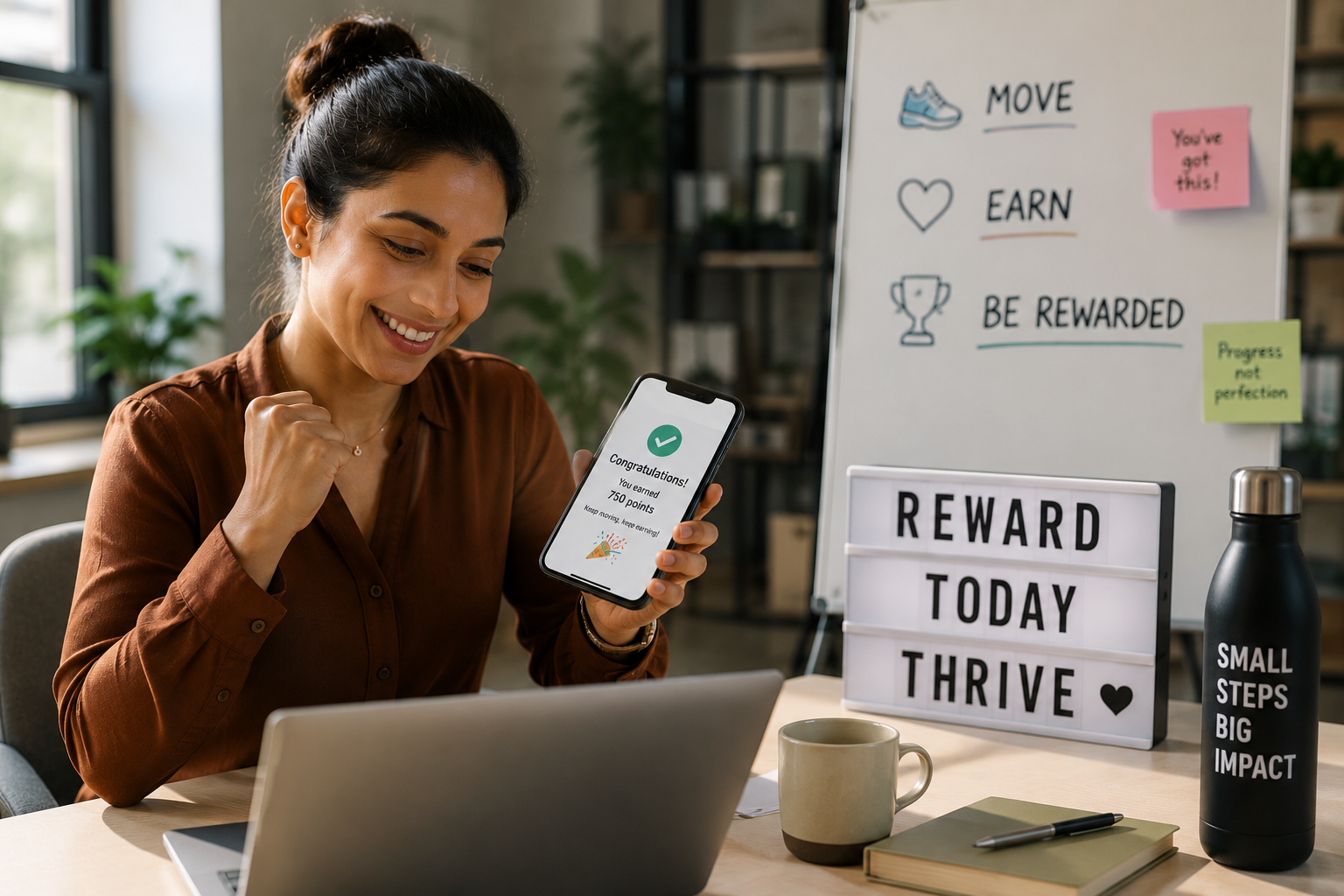
Employees disengage from workplace reward programmes when recognition becomes predictable, delayed, or reserved for top performers. The fix is not a bigger prize catalogue, it is a reward model tied to ongoing daily behaviour rather than end-of-quarter milestones. GoJoe's move-to-earn model, which links physical activity directly to redeemable voucher value across 9,000+ brands, achieves engagement rates of around 90% in corporate programmes. The differentiator is that rewards are earned continuously, not distributed occasionally.
Key Takeaways
• Reward fatigue sets in when recognition feels formulaic, infrequent, or only accessible to the highest performers.
• Employees stay engaged when rewards are visible, achievable, and tied to behaviours they can repeat every day.
• Social mechanics and team accountability sustain participation more reliably than one-off financial prizes.
• GoJoe platform data shows an 18% increase in self-reported productivity and a 40% reduction in stress among employees with sustained engagement — outcomes that require consistent daily participation, not a campaign.
• Redemption rates are a vanity metric. Behaviour change, repeat participation, and wellbeing outcomes are the indicators that matter.
Why Do Traditional Workplace Reward Programmes Lose Their Impact?
Most reward programmes start strong because novelty drives short-term attention. Employees learn the pattern; complete a task, earn points, collect a gift, and then the loop stops producing a meaningful response. When the reward is predictable and the process is transactional, recognition loses emotional impact.
The scale of this problem is significant. Gallup's State of the Global Workplace report consistently shows that only around 21% of employees are engaged at work globally, despite years of investment in recognition and incentive schemes. Highly engaged teams outperform on productivity and absenteeism, but most reward programmes are not designed to produce engagement. They are designed to distribute recognition.
The distinction matters. Distribution is a one-way event. Engagement is an ongoing state. The best employee reward platforms in 2026 are built around the second, frequent, visible, behaviour-linked recognition that gives employees a reason to participate every week, not just in Q4.
Why Do Rewards Feel Less Valuable When They Are Delayed?
The gap between behaviour and recognition is where motivation dies. If an employee has to wait weeks or months for acknowledgement of something they did in January, the reward arrives without the emotional context that made the behaviour meaningful. The feedback loop is broken.
GoJoe's move-to-earn model is built around closing that gap. Employees log activity through the same platform they use for team challenges — no additional hardware required. Points accumulate monthly against a threshold that reflects their employer's budget and difficulty setting. Once reached, those points are redeemable against vouchers across 9,000+ brands in 180 countries. The more an employee moves, the more they earn. The connection between daily behaviour and tangible reward value is direct and visible in real time.
This is structurally different from a manager nominating someone for a spot bonus or a platform issuing a voucher at year-end. The reward is not a judgment call — it is an automatic outcome of behaviour the employee controls.
Why Does Inclusive Recognition Outperform Winner-Takes-All Models?
When only high performers can win, most employees conclude early that participation is pointless. That withdrawal is rational — if the reward is unachievable, there is no reason to change behaviour. The result is that the programme deepens existing performance gaps rather than improving workforce-wide wellbeing.
Inclusive reward models — where participation itself is the qualifying criterion, not rank — solve this structurally. GoJoe's activity-based engagement is designed to give less active employees a meaningful path to recognition. The programme rewards effort and consistency, not athletic ability.
At Coutts Bank, this approach produced a 43% increase in employee participation. That figure reflects engagement across the workforce, not just among already-active employees.
Why Does Social Motivation Outlast Financial Incentives?
Financial prizes create short-term attention. Social mechanics create habits. The difference is that a cash prize or voucher is consumed once and forgotten, whereas a team challenge, a shared leaderboard, or a collective goal produces ongoing interaction that keeps employees returning to the platform.
GoJoe platform data shows that employees who participate in team-based challenges sustain engagement at significantly higher rates than those in individual-only programmes. The social accountability layer, knowing that your participation or inactivity is visible to colleagues, is particularly effective in distributed and hybrid workforces where informal peer accountability does not happen naturally.
The outcome data bears this out. GoJoe platform data across sustained corporate programmes shows an 18% increase in employees reporting high productivity and a 40% reduction in employees reporting stress or feeling overwhelmed.
These outcomes are associated with consistent, long-term engagement. not a one-off campaign or a single rewards redemption event.
What Should Companies Measure Instead of Reward Redemptions?
Redemption rate tells you how attractive your prize catalogue is. It does not tell you whether the programme is changing behaviour or improving workforce health. HR leaders and People Directors who need to justify benefits spend to a board require a different evidence base:
• Repeat participation rates week-on-week
• Weekly active users as a percentage of enrolled employees
• Employee sentiment scores tracked over 12+ months
• Absenteeism trends (NatWest recorded a 10% reduction in absenteeism costs in the first 18 months of sustained GoJoe participation)
• Self-reported productivity and stress indicators
The programmes that earn continued investment are the ones that produce this evidence. Redemption rates do not survive a CFO question about ROI. Absenteeism reduction and productivity data do.
Conclusion
Employees stop caring about workplace rewards when recognition is predictable, delayed, or structurally exclusive. The answer is not more generous prizes — it is better reward design. Programmes that tie recognition to ongoing daily behaviour, make progress visible in real time, and use social mechanics to distribute accountability consistently outperform point-and-redeem catalogues.
For HR leaders evaluating employee reward platforms in 2026, the question is not which platform has the most brands in its voucher catalogue. It is which platform is designed to still be used in month seven — and which has the data to prove it.
FAQs
Q1. Why do employee rewards stop working after a few months?
Reward programmes lose impact when recognition becomes predictable and the connection between behaviour and reward is weak or delayed. Employees learn the system quickly — and when the system stops producing a meaningful response, they stop engaging with it. The fix is a reward model that ties recognition to repeatable daily behaviours rather than infrequent milestones, and that keeps the feedback loop between action and reward as short as possible.
Q2. What should companies look for in employee reward platforms in 2026?
The most important features are behaviour-linked reward mechanics (not just point accumulation), inclusive participation models that work for employees at all activity levels, social and team-based engagement tools, real-time progress visibility, and admin analytics that track behaviour change rather than just redemption activity. Platforms that combine these features consistently outperform catalogue-only recognition tools on long-term engagement.
Q3. Are wellbeing rewards more effective than financial incentives?
For sustained behaviour change, yes. A one-off financial bonus creates a momentary response. A reward model that continuously recognises healthy behaviour — and makes that recognition social and visible — builds habits over time. GoJoe platform data shows that employees with sustained engagement report an 18% increase in productivity and a 40% reduction in stress: outcomes that require weeks of consistent participation, not a single reward event.
Q4. How do companies measure whether a reward programme is actually working?
Beyond redemption rates, the indicators that reflect genuine programme health are: repeat weekly participation, employee sentiment over 12+ months, absenteeism trends, cross-team involvement, and self-reported productivity. These are the metrics that translate into a credible ROI conversation with senior leadership — and the metrics that the best employee reward platforms are built to surface automatically.
Q5. Can reward programmes measurably improve employee productivity?
Yes — but only when the programme is designed for sustained engagement rather than a one-off campaign. GoJoe's platform data shows an 18% increase in self-reported productivity among employees with consistent, long-term participation. NatWest recorded a 10% reduction in absenteeism costs in the first 18 months of running GoJoe across their workforce. Both outcomes are products of sustained behaviour change, not reward distribution.