Ed is Head of Marketing at GoJoe, helping grow the businesses globally as well as working with clients to support internal engagement.
Quick Answer: A successful corporate wellness strategy is built in four layers: define your purpose and goals; choose wellbeing pillars (Move, Fuel, Rest, Feel, Connect); design the employee experience through a platform that makes wellbeing social and trackable; then close the loop with recognition, rewards, and measurement. The most common failure point is Layer 3 — the employee experience — where programmes collapse without social mechanics and year-round participation design. GoJoe clients using all four layers average 90%+ workforce participation and see measurable outcomes within 6–12 weeks.
How do you turn "we care about wellbeing" from a slogan into something people actually feel day to day? A growing number of organisations are investing in corporate wellness platforms to answer exactly that question. When wellbeing is structured, measurable, and supported by the right tools, you get healthier, more engaged teams — not just another HR initiative that fizzles out.
In this guide, we'll walk through how to build a practical, human-centred corporate wellness strategy and where a modern employee wellness platform like GoJoe acts as your engine for engagement, behaviour change, and long-term participation.
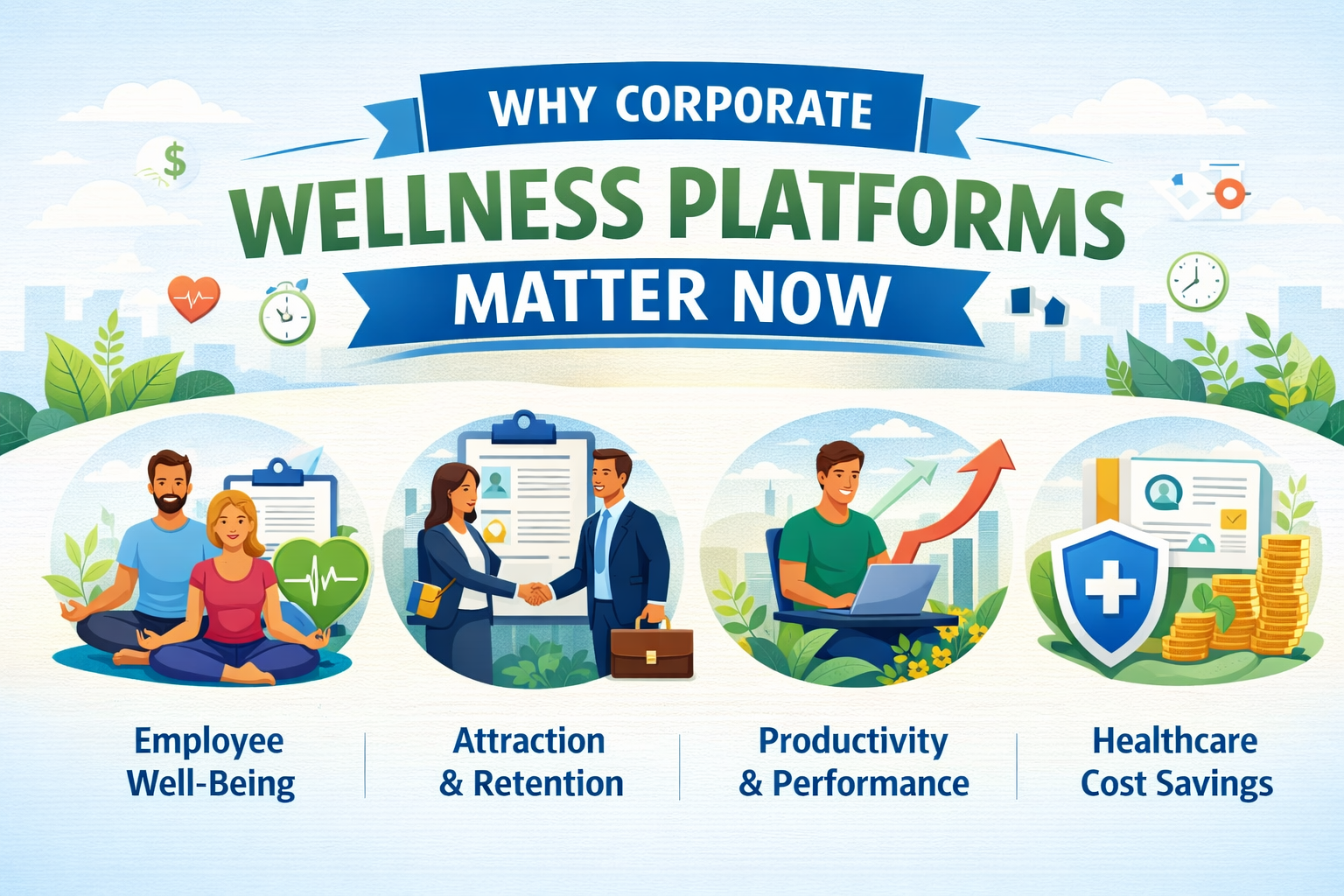
Why Do Corporate Wellness Platforms Matter Now?
Corporate wellness platforms bring together challenges, content, tracking, rewards, and social features in one place. Instead of scattered initiatives, you get a single hub where employees can see what's happening, join in, and track their own progress.
For HR and leadership, this means wellbeing stops being a collection of one-off events and becomes a continuous, data-driven part of your culture. Done well, this improves energy, reduces absence, and makes it easier to attract and keep great people.
How to Build a Corporate Wellness Strategy: A Layered Approach
Think of your corporate wellness strategy as four layers, each building on the last. This structure keeps things clear for HR and simple for employees.
Layer 1: Purpose and Principles
Before tools and tactics, decide why wellness matters to your organisation.
Agree on principles like inclusivity, simplicity, and voluntary participation.
Align your wellness goals with wider people and business objectives.
Layer 2: Pillars of Wellbeing
Choose a small set of wellbeing pillars that reflect your culture and what your people need most.
Common pillars:
Move – physical activity and energy
Fuel – nutrition and healthy routines
Rest – sleep and recovery
Feel – mental health, stress, and resilience
Connect – social connection and belonging
Your corporate wellness platform and activities should map clearly onto these pillars so employees know what each initiative is trying to support.
Layer 3: Experience and Engagement
This is where your employee wellness platform comes in. You're designing the everyday experience of wellbeing at work.
Key questions:
How will people hear about and join activities (mobile app, desktop, internal comms)?
What mix of individual and team-based challenges will you offer?
How will you make it feel fun and social, not like another task?
Here, features like leaderboards, team challenges, social feeds, and simple tracking turn vague "wellbeing goals" into tangible actions.
Layer 4: Recognition, Rewards, and Measurement
The final layer turns your strategy into a system that sustains itself over time.
Recognition: Shout-outs, stories, and internal spotlights for people and teams living your wellbeing values.
Rewards: GoJoe's move-to-earn model converts every step, cycle, or swim into redeemable voucher value. Employees earn as they move — across 9,000+ brands in 180 countries.
Measurement: Track absence rates, stress scores, engagement survey results, and participation data. Set a baseline before launch and review at 90 days and 12 months.
What Are the Most Common Corporate Wellness Mistakes?
The most common mistakes HR teams make when building a corporate wellness strategy:
Launching without a year-round plan. One-off challenges generate short-term spikes but not behaviour change. Design for month 7, not month 1.
Choosing platforms built for individuals, not teams. Individual activity apps create usage by the already-active minority. Team-based platforms drive participation across the whole workforce.
Measuring the wrong things. Sign-up rates and app downloads tell you about launch quality, not programme health. Track absence, stress, productivity, and retention.
Under-investing in manager involvement. When line managers don't participate or champion the programme, adoption drops. Manager buy-in is a prerequisite, not a nice-to-have.
Ignoring the hybrid divide. Programmes designed around office-based activities exclude remote employees. GoJoe's app-based challenges work identically regardless of location.
How Does GoJoe Support Corporate Wellness Strategy?
GoJoe is a workforce wellbeing platform that acts as the engine for Layers 3 and 4 of your strategy. It delivers:
Team-based challenges across any physical activity — tracked via GPS or manual log, no wearable required
Social mechanics (leaderboards, team feeds, kudos) that create daily engagement loops
Move-to-earn rewards linked to participation, not performance — every employee earns regardless of activity level
Real-time admin dashboards for HR teams to track participation and outcomes
Programme design support and onboarding for enterprise deployments
GoJoe clients report up to 18% improvement in self-reported productivity, 40% reduction in stress, and 74% improvement in work-life balance. NatWest saw a 10% reduction in absenteeism. Coutts achieved 43% workforce participation in their first challenge cycle. Hilti saw 51% of employees report improved team connection.
Frequently Asked Questions
How do you build a successful corporate wellness strategy?
A successful corporate wellness strategy is built in four layers: define purpose and 2-3 core goals; choose wellbeing pillars that reflect your culture; design the employee experience through a platform that makes wellbeing social, trackable, and rewarding; then close the loop with recognition, rewards, and measurement. GoJoe serves as the engagement engine for the experience and measurement layers, achieving 90%+ participation across enterprise workforces.
What are the key pillars of a corporate wellness programme?
The most effective corporate wellness pillars are Move (physical activity), Fuel (nutrition), Rest (recovery), Feel (mental health and resilience), and Connect (social connection). Most programmes underinvest in Connect — the social pillar — which is why team-based challenges drive disproportionate engagement: they address multiple pillars simultaneously.
How do you measure the ROI of a corporate wellness strategy?
Track four metrics before and after any major wellness initiative: absence rate, presenteeism score, engagement score, and voluntary turnover rate. GoJoe clients report ROI within 6–12 weeks through improved attendance and engagement. NatWest saw 10% absenteeism reduction; Coutts achieved 43% workforce participation.
What makes a corporate wellness platform effective?
Effective platforms combine challenges, content, tracking, rewards, and social features in one place. The critical differentiator is whether the platform is designed for year-round use or one-off campaigns. GoJoe builds in leaderboards, team challenges, social feeds, and a move-to-earn reward model that creates daily engagement loops rather than campaign spikes.
How do you get employees to actually use a wellness programme?
The three factors that drive sustained participation are: inclusivity (everyone can join regardless of activity level), social accountability (team-based formats create shared stakes), and visible rewards (tangible outcomes from participation). Senior leader participation at launch is the single most reliable predictor of workforce adoption.