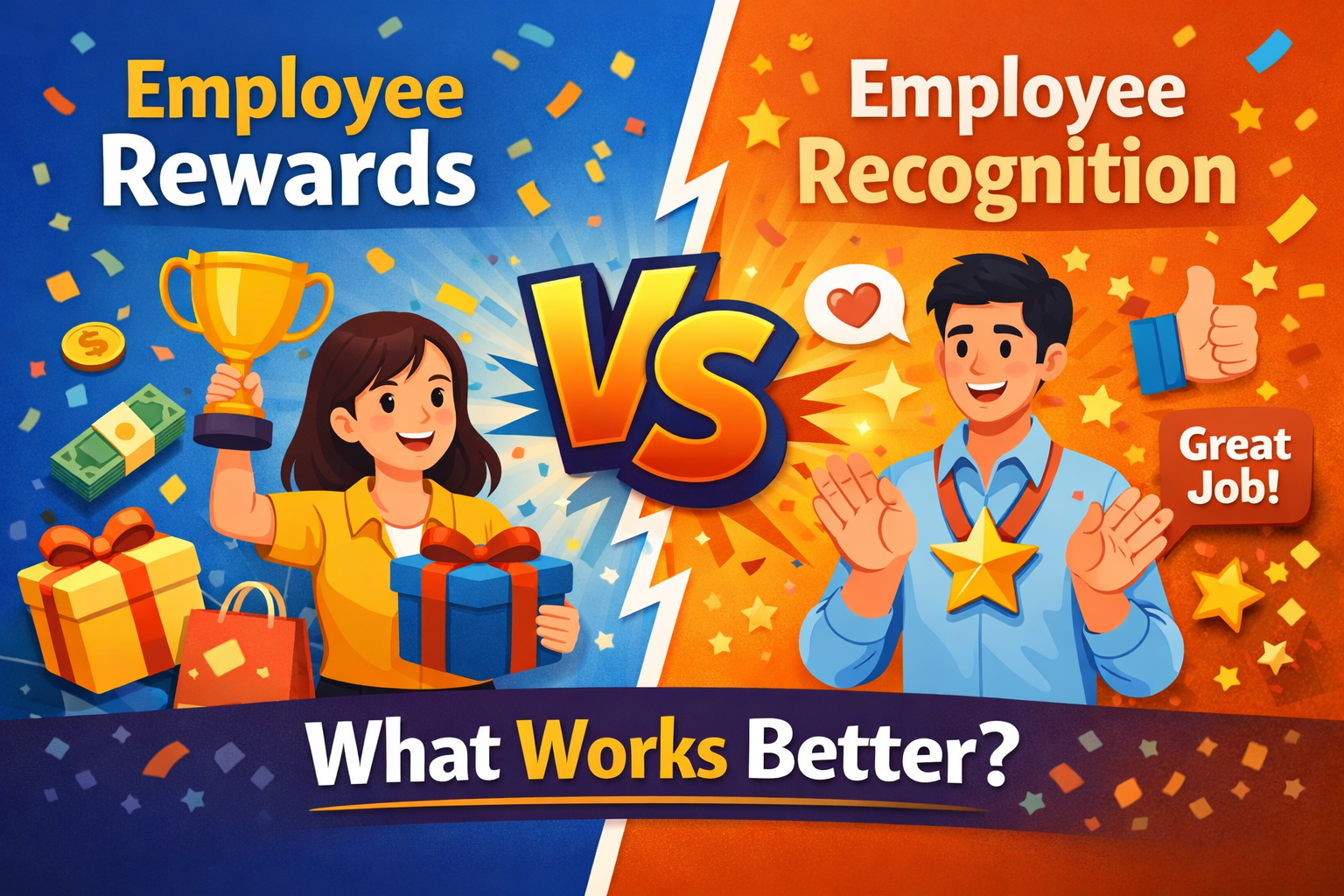
Quick Answer: Employee rewards and employee recognition are not the same thing, and confusing them is one of the most common reasons engagement programmes underdeliver. Rewards are tangible — points, vouchers, experiences linked to a specific behaviour. Recognition is psychological — the acknowledgement, praise, or visibility that validates effort. Both matter, but for different reasons. The most effective HR strategies in 2026 combine both: structured rewards that drive consistent behaviour, and meaningful recognition that builds belonging. GoJoe delivers this combination through move-to-earn rewards and team challenges, producing a 40% drop in stress and 18% improvement in productivity across the workforce.
HR leaders spend significant budget on employee rewards and recognition programmes each year. Many do not get the return they expect. The reason is almost always a failure to understand what each mechanism actually does — and when to use which one.
This guide covers the psychological distinction between rewards and recognition, when each is most effective, and how to combine both to drive sustainable engagement. GoJoe is an employee rewards platform that integrates both mechanisms to create measurable business outcomes.
What Is the Difference Between Employee Rewards and Employee Recognition?
The distinction is more important than most HR guides acknowledge.
Employee rewards are tangible, behaviour-linked outcomes. An employee completes a health challenge: they earn points. Points convert to vouchers, experiences, or cash equivalents. The reward exists to change behaviour — to create a direct link between a specific action and a valuable outcome. Done well, rewards build habits. Done poorly, they become expected entitlements that erode motivation when removed.
Employee recognition is acknowledgement — verbal, written, or public validation that an employee's contribution has been seen and valued. It is psychological rather than transactional. Recognition does not need to cost anything. What it needs is to be specific, timely, and genuine. Research consistently shows that employees who receive recognition in the past seven days are 4x more likely to be engaged.
The two mechanisms work on different parts of employee motivation. Rewards address extrinsic motivation: they make specific behaviours worthwhile. Recognition addresses intrinsic motivation: it makes employees feel that who they are and what they do matters. Both are necessary. Neither is sufficient on its own.
Why Rewards Without Recognition Falls Short
A purely transactional reward programme tells employees their value is measured in points. Over time, this creates a mercenary culture where employees perform for rewards and disengage when the reward cycle ends. Many corporate step challenges see exactly this pattern: high launch-week participation, sharp drop-off at week three.
Rewards without recognition also miss the social dimension of engagement. Coutts achieved 43% active challenge participation with GoJoe — not because the rewards were exceptional, but because team-based challenges created visible shared effort where colleagues recognised each other's contribution. The social accountability and peer recognition embedded in the challenge format were as important as the reward structure.
Why Recognition Without Rewards Is Incomplete
Recognition-only programmes work well for individual performance acknowledgement. They struggle to create the daily habit loops that sustained engagement requires. Telling someone they did a great job last quarter does not give them a reason to make healthier choices tomorrow.
For health and wellbeing programmes specifically, recognition needs a behavioural mechanism attached. GoJoe's move-to-earn model links physical activity directly to reward accumulation — employees earn points for every activity session, redeemable for rewards they choose. The recognition layer (team leaderboards, challenge milestones, manager dashboards) sits on top of this behavioural foundation. Remove the rewards and the daily habit suffers. Remove the recognition and the social belonging suffers. Both matter.
How GoJoe Combines Rewards and Recognition
GoJoe's platform is built around the interaction between tangible rewards and social recognition:
• Move-to-earn: Employees earn points for any physical activity across 600+ activity types. Points are redeemable for rewards, creating a direct behaviour-to-reward loop.
• Team challenges: Shared goals create peer visibility and mutual accountability. When a colleague completes a session, the team sees it. That visibility is recognition in real time.
• Manager dashboards: HR and line managers see participation data by team, enabling targeted recognition for consistent contributors.
• Recognition pot: Organisations can allocate a recognition budget that managers distribute as peer-to-peer awards — a direct integration of both mechanisms in one platform.
The outcome data from this combined approach is clear: 40% drop in stress, 18% productivity improvement, 43% active challenge participation at Coutts, 10% absenteeism cost reduction at NatWest over 18 months.
Practical Guidance: When to Use Rewards vs Recognition
Use rewards when you want to: build a new daily health or productivity habit, increase participation in a structured programme, create a tangible link between behaviour and value, or incentivise behaviours that are not intrinsically motivating for every employee.
Use recognition when you want to: reinforce exceptional individual performance, build a culture of peer appreciation, acknowledge effort that cannot be quantified in points, or create visible social proof of the behaviours you want more of.
Use both when you want sustained engagement over months, not just a spike at launch. The strongest programmes treat rewards as the engine and recognition as the fuel — consistent behaviour driven by tangible incentive, sustained by the social experience of being seen.
Frequently Asked Questions
What is the difference between employee rewards and employee recognition?
Rewards are tangible and behaviour-linked — points, vouchers, experiences earned for specific actions. Recognition is psychological — acknowledgement that an employee's contribution has been seen and valued. Rewards change behaviour. Recognition builds belonging. Both are necessary for sustained engagement.
Which is more important: rewards or recognition?
Neither is more important — they work on different motivational levers. Rewards drive consistent daily behaviours. Recognition creates the sense of belonging that makes employees want to stay and contribute. Programmes that neglect either see lower sustained engagement than those that combine both.
Do employee rewards actually improve productivity?
Yes, when linked to the right behaviours. GoJoe data shows an 18% productivity improvement and 40% stress reduction across users on the platform. The key is that rewards must be tied to specific health or performance behaviours — not distributed as blanket bonuses that employees disconnect from their daily actions.
How does GoJoe combine rewards and recognition?
GoJoe's move-to-earn model gives employees points for any physical activity, redeemable for rewards they choose. Team challenges add social visibility — peer recognition in real time. Manager dashboards and a recognition pot allow HR teams to layer targeted individual recognition on top of the behavioural reward structure.
What is the best employee rewards and recognition platform for 2026?
The best platform connects rewards to behaviours that improve employee health and wellbeing, provides real-time social recognition through team participation, gives HR measurable outcome data, and sustains engagement beyond the launch spike. GoJoe achieves 80-90%+ sustained challenge participation with enterprise clients including Coutts, NatWest, and Hilti.
Keep Reading